Strengthen & Restore Root Canal Treated Teeth with Advanced Restorative Dentistry
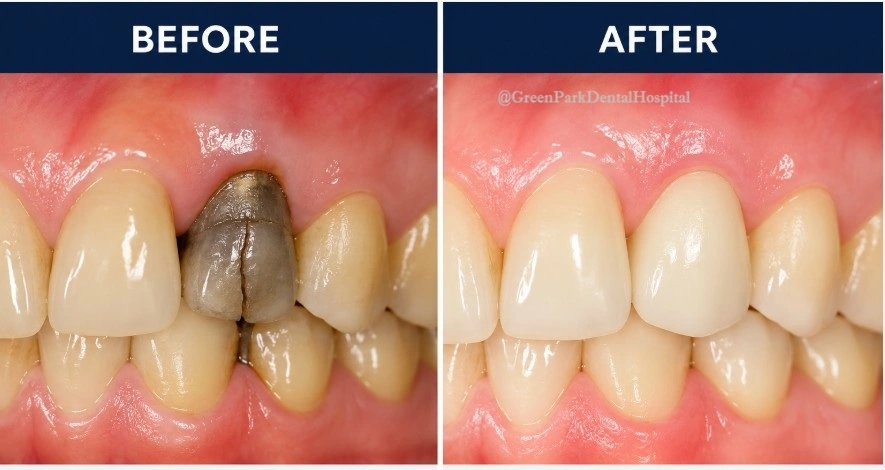
At Green Park Dental Hospital, we provide advanced Post & Core treatment to restore severely damaged or weakened teeth, especially after Root Canal Treatment (RCT). When a tooth has lost a large amount of its natural structure due to decay, fracture, or infection, a post and core restoration helps rebuild the tooth and provide support for a dental crown.
Post & Core treatment is an important restorative procedure that improves the strength, stability, and long-term survival of damaged teeth while preserving natural tooth structure whenever possible.
Our advanced restorative procedures are guided by Dr. Syed Arshad Javeed, known for precision restorative dentistry, dental implants, and full mouth rehabilitation.
What Is Post & Core Treatment?
Post & Core is a restorative dental procedure used to rebuild a tooth that has undergone root canal treatment and has insufficient natural tooth structure remaining for crown support.
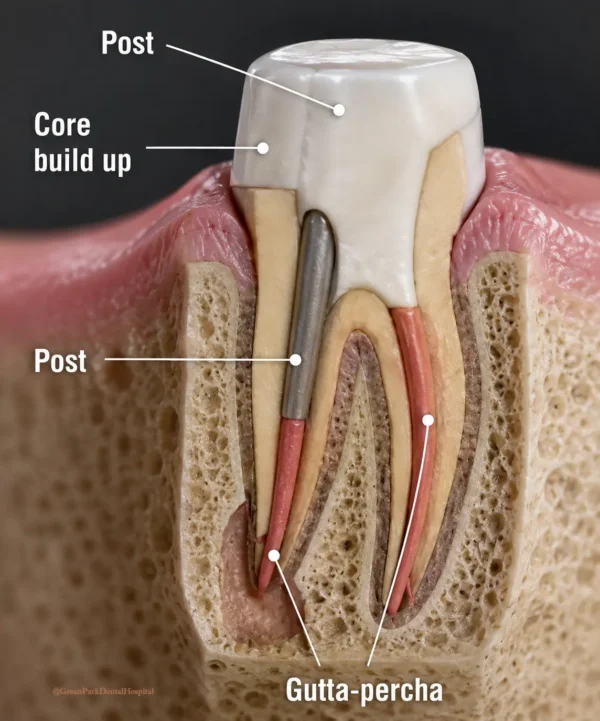
The restoration has two main parts:
Post
A small rod-like structure placed inside the root canal of the treated tooth to provide internal support.
Core
A buildup material placed around the post to recreate the lost tooth structure and support the final crown.
The crown is then placed over the rebuilt tooth for long-term protection and function.
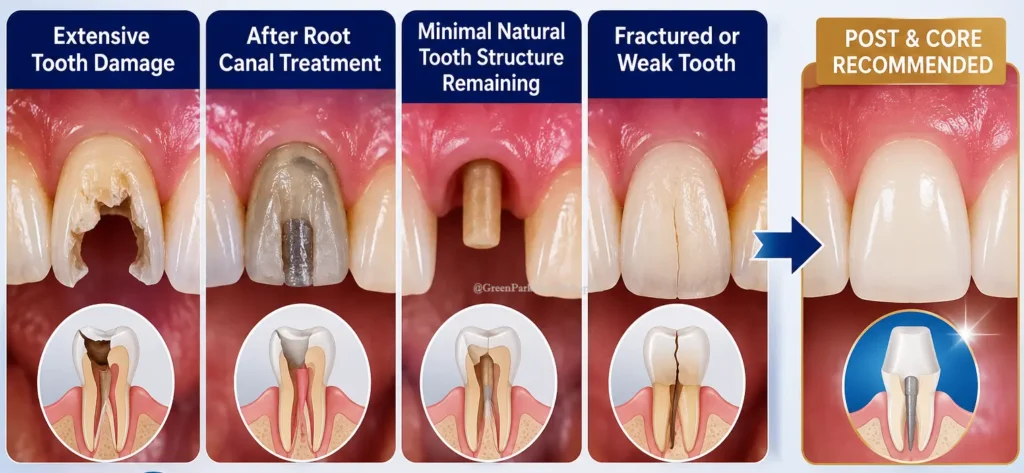
Why Is Post & Core Needed?
Post & Core treatment is recommended when:
- Large portions of the tooth are missing
- The tooth is severely broken down
- Root canal treated teeth become weak
- There is insufficient tooth structure for crown retention
- Trauma or decay has damaged the tooth extensively
Without proper reinforcement, weakened teeth are at higher risk of fracture or crown failure.
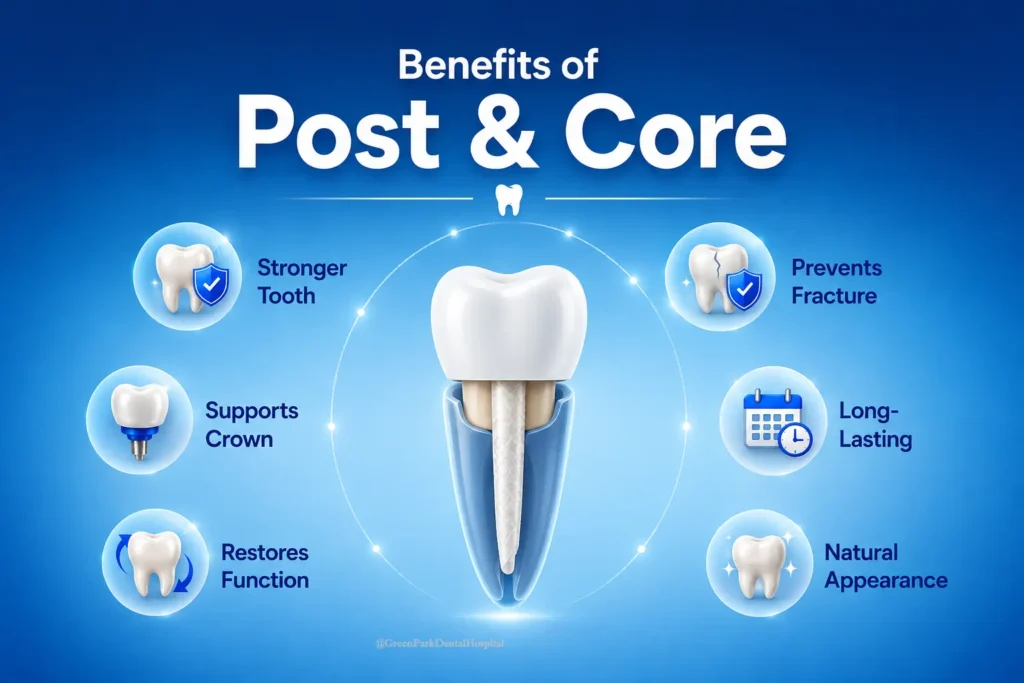
Benefits of Post & Core Treatment
Strengthens Weak Teeth
Provides internal support to weakened root canal treated teeth.
Supports Dental Crowns
Creates a stable foundation for crown placement.
Preserves Natural Teeth
Helps save teeth that might otherwise require extraction.
Restores Function
Improves chewing ability and bite strength.
Improves Smile Aesthetics
Supports aesthetic crown restorations for a natural appearance.
Long-Term Tooth Preservation
Enhances durability and longevity of restorative treatment.
Types of Dental Posts
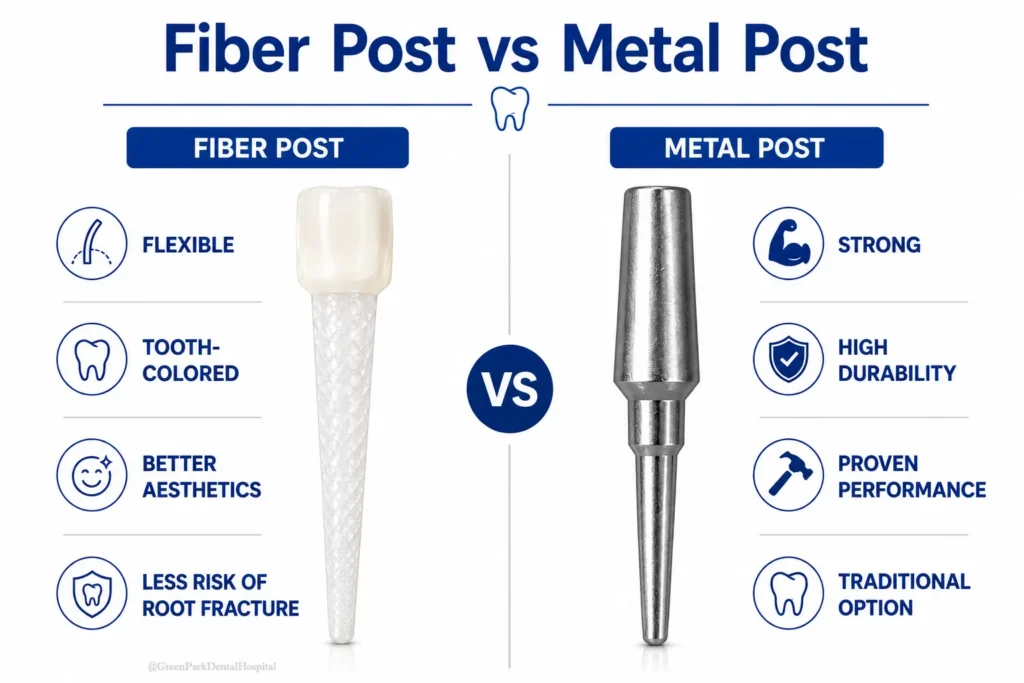
Fiber Posts
Fiber posts are modern tooth-colored posts commonly used in aesthetic restorative dentistry. Fiber-reinforced posts have an elastic modulus closer to dentin than many metal posts, which may help distribute functional stresses more favorably in selected clinical situations.
Advantages:
- Tooth-colored aesthetics
- Better flexibility
- Reduced fracture risk
- Natural stress distribution
- Ideal for front teeth
Fiber posts are widely preferred because they closely mimic the mechanical properties of natural teeth.
Metal Posts
Metal posts may be fabricated using stainless steel or custom cast metal materials.
Advantages:
- High strength
- Durable support
- Suitable for heavily damaged teeth
Metal posts are sometimes used in posterior teeth requiring additional strength. The choice between fiber posts, prefabricated metal posts, and cast post-and-core restorations depends on remaining tooth structure, root anatomy, functional demands, esthetic requirements, and long-term prognosis.
Cast Post & Core
Custom-made cast restorations are fabricated in dental laboratories for severely damaged teeth.
Advantages:
- Precise fit
- Strong support
- Suitable for complex restorations
Ferrule Effect
This is one of the most important factors affecting post & core success.
Importance of the Ferrule Effect
Successful post & core restorations depend not only on the post itself but also on preserving healthy tooth structure above the gum line.
A circumferential band of remaining tooth structure, known as the ferrule, helps:
✓ Improve fracture resistance
✓ Enhance crown retention
✓ Improve long-term prognosis
✓ Reduce restoration failure risk
Adequate ferrule is often considered one of the most important predictors of treatment success.
Modern Advancements
CAD/CAM Restorative Dentistry For Digital Restorative Planning
Modern restorative dentistry increasingly uses digital technologies for diagnosis, treatment planning, and crown fabrication.
Benefits include:
✓ Improved accuracy
✓ Better crown fit
✓ Predictable esthetics
✓ Enhanced treatment planning
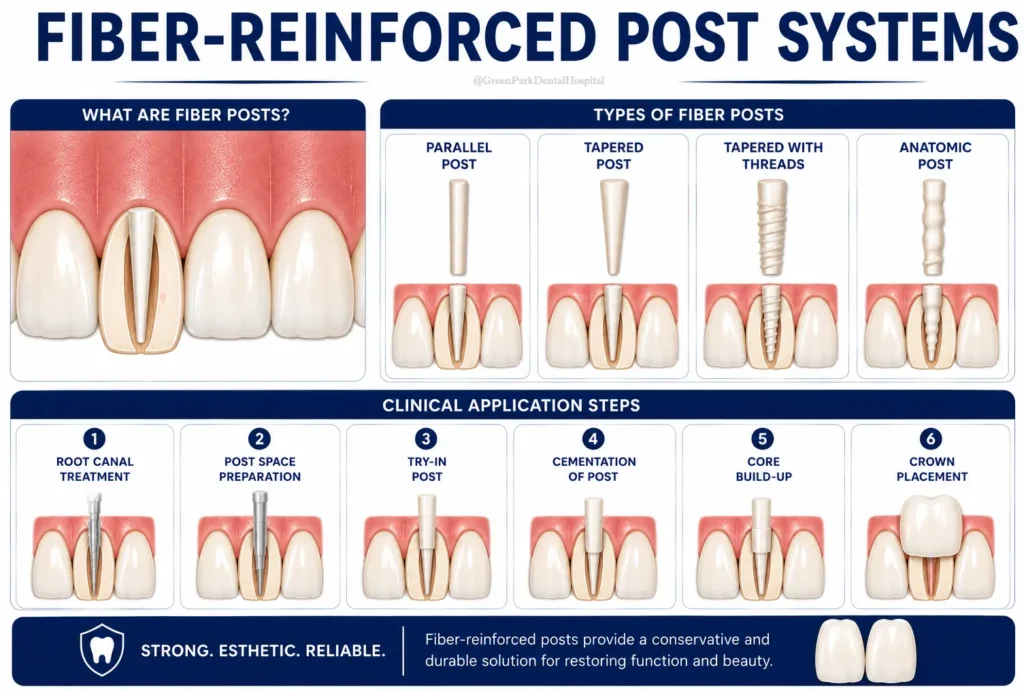
Fiber-Reinforced Post Systems
Modern fiber-reinforced post systems are designed to:
✓ Preserve more tooth structure
✓ Support adhesive bonding
✓ Improve esthetics
✓ Reduce metal visibility in anterior teeth
Advanced Adhesive Dentistry
Modern bonding systems allow stronger integration between:
✓ Tooth structure
✓ Core materials
✓ Fiber posts
✓ Final restorations
This contributes to improved retention and restorative predictability.
When Is Post & Core Recommended?
Post & Core treatment may be required in cases of:
- Extensive tooth decay
- Fractured teeth
- Broken root canal treated teeth
- Large old fillings
- Trauma-related tooth damage
- Severe tooth wear
Not every root canal treated tooth requires a post. The need depends on the amount of remaining tooth structure.
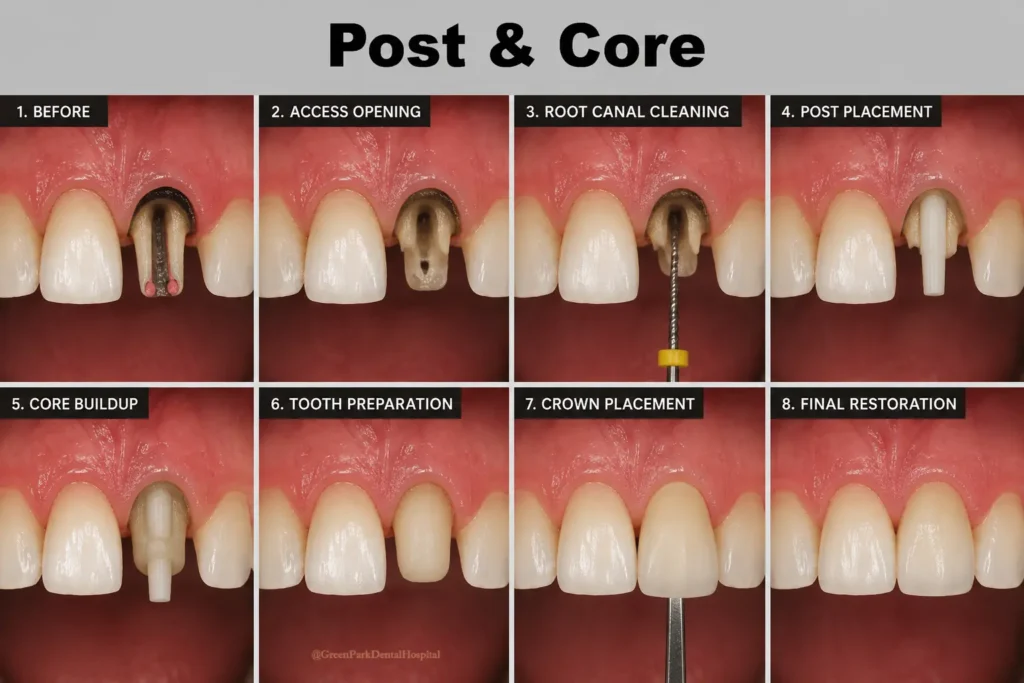
Post & Core Procedure
At Green Park Dental Hospital, Post & Core treatment is performed using precision restorative techniques for long-term stability and aesthetics.
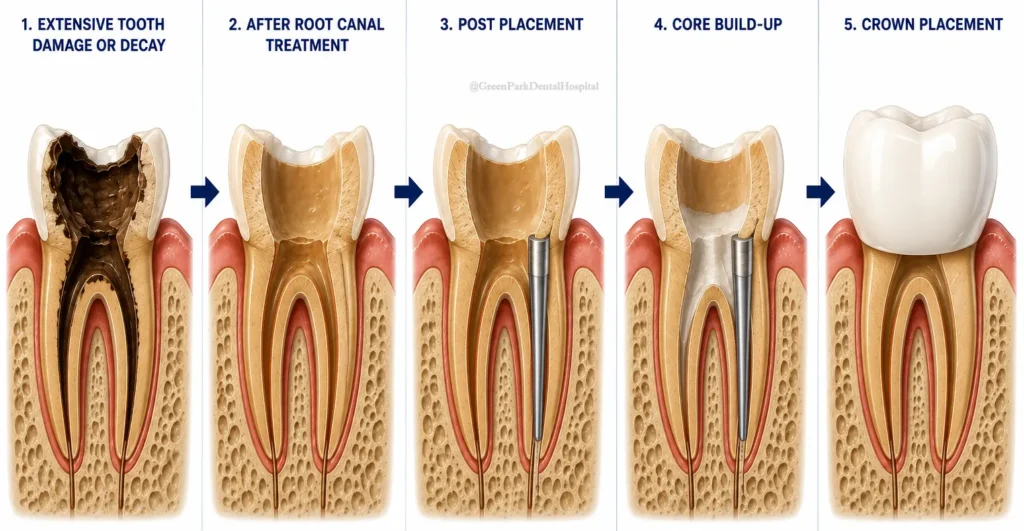
1. Dental Examination & X-rays
The dentist evaluates root strength, remaining tooth structure, and root canal condition.
2. Root Canal Evaluation
The previously treated root canal is assessed for adequate sealing and healing.
3. Post Space Preparation
A portion of the root canal filling material is carefully removed to create space for the post.
4. Post Placement
The selected post is securely placed inside the root canal using dental adhesive or cement.
5. Core Build-Up
A strong core material is used to rebuild the missing tooth structure.
6. Crown Preparation
The rebuilt tooth is prepared for crown placement.
7. Final Crown Restoration
A ceramic or zirconia crown is placed over the tooth for long-term protection and aesthetics.
Is Post & Core Treatment Painful?
Post & Core procedures are generally comfortable because the tooth has already undergone root canal treatment. Local anesthesia may be used when necessary for patient comfort.
Most patients experience minimal discomfort during and after treatment.
Post & Core vs Dental Implant
Feature | Post & Core | Dental Implant |
Tooth Preservation | Saves natural tooth | Replaces missing tooth |
Procedure Type | Restorative | Surgical replacement |
Best For | Damaged existing tooth | Missing or non-restorable tooth |
Support Structure | Natural root | Titanium implant |
Goal | Strengthen existing tooth | Replace extracted tooth |
Whenever possible, preserving the natural tooth with post and core treatment is often preferred before considering extraction and implant placement.
Advanced Restorative Dentistry at Green Park Dental Hospital
We use modern restorative dentistry technology for precise and durable restorations:
- Fiber post systems
- Digital restorative planning
- Zirconia & ceramic crowns
- Precision crown fabrication
- Digital dental diagnostics
- Advanced adhesive dentistry
These technologies improve fit, aesthetics, and long-term treatment success.
Why Choose Green Park Dental Hospital for Post & Core Treatment?
Patients trust Green Park Dental Hospital for advanced restorative dentistry because we focus on preserving natural teeth with modern treatment techniques.
Why choose us:
- Expertise in restorative dentistry
- Advanced post & core techniques
- Precision crown restorations
- Modern digital dental workflow
- Aesthetic smile rehabilitation
- Comfortable and hygienic environment
- Personalized treatment planning
- Advanced implant & rehabilitation expertise
Our restorative dental procedures are guided by Dr. Syed Arshad Javeed, known for advanced smile rehabilitation and restorative dentistry.
Post-Treatment Care After Post & Core Restoration
To maintain your restoration:
- Brush and floss regularly
- Avoid biting hard objects
- Maintain regular dental checkups
- Wear a night guard if advised
- Maintain good oral hygiene
- Get the final crown placed promptly if recommended
Proper care significantly improves restoration longevity.
(FAQ) Frequently Asked Questions
Book Your Post & Core Consultation in Hyderabad
Restore and strengthen damaged teeth with advanced Post & Core treatment at Green Park Dental Hospital. Whether you have a weakened root canal treated tooth, fractured tooth, or extensive decay, our experienced dental team is here to provide personalized restorative solutions.
Schedule your consultation today with Dr. Syed Arshad Javeed and experience advanced restorative dentistry focused on preserving your natural smile.














Oxmox advised her not to do so, because there were thousands of bad Commas, wild Question Marks and devious.
Kolis Muller NY Citizen